
Mounts in general
A mount is at least as important as the telescope optics. It should be chosen large enough to carry the telescope with low vibration.
Every mount has two axes: With altazimuth mounts, the telescope is moved in altitude and azimuth (horizontal). With equatorial mounts, however, one axis is aligned parallel to the Earth's axis. This is absolutely necessary for astrophotography with long exposure times. With a photo mount, you can use a camera with interchangeable lenses. This is ideal for travel!
The term GoTo refers to a computer control system. This makes it easier to find the desired object.
With an altazimuth mount, a telescope can be swiveled in altitude and along the horizon. This horizontal angle is also called the azimuth. Altazimuth mounts can be set up simply like a camera tripod. The advantage is that some altazimuth mounts are set up to attach two telescopes simultaneously - as in the picture here.
A particularly simple example is the Dobsonian mount. The goal was to have the largest possible telescope on a mount at a favorable price. This was achieved: a Newtonian telescope sits on a wooden box and can be moved freely in azimuth (horizontal) and altitude. The construction of the box is very simple: it consists of only a few parts that are assembled according to the Ikea principle. For easy movement, the telescope or the box has sliding and slewing bearings. This allows you to move the telescope into any position, often with just one finger.
Equatorial mounts are constructed in such a way that one axis must be aligned parallel to the Earth's axis. This means the telescope only has to be rotated around this axis – called the hour axis – to compensate for the rotation of the sky. The selected celestial object thus remains centered in the eyepiece at all times.
To align the hour axis parallel to the Earth's axis, the north direction and the geographical latitude of the observation location must be known. If the equatorial mount has a polar finder, the Pole Star can also simply be aimed at.
A special case of the equatorial mount is the photo mount. These are very easily transportable mounts on which cameras can be placed. The photo mounts thus enable the compensation of the sky's rotation, which is necessary for long-exposure shots. They are essentially very small, equatorial mounts for astrophotographic use. The larger models of the photo mount also allow the use of heavy camera lenses or small telescopes.
Eine Montierung ist mindestens so wichtig wie die Teleskop-Optik. Sie sollte groß genug gewählt sein, um das Teleskop schwingungsarm zu tragen.
Jede Montierung verfügt über zwei Achsen: Bei azimutalen Montierungen wird das Teleskop in Höhe und Horizont (Azimut) bewegt. Bei parallaktischen Montierungen hingegen wird eine Achse parallel zur Erdachse ausgerichtet. Für die Astrofotografie mit langen Belichtungszeiten ist das zwingend notwendig. Mit einer Fotomontierung können Sie eine Kamera mit Wechselobjektiven verwenden. Das ist ideal für die Reise!
Unter dem Begriff GoTo versteht man eine Computer-Steuerung. Diese erleichtert das Auffinden des gewünschten Objekts.
(https://www.astroshop.de/montierungen-zubehoer/15_55)
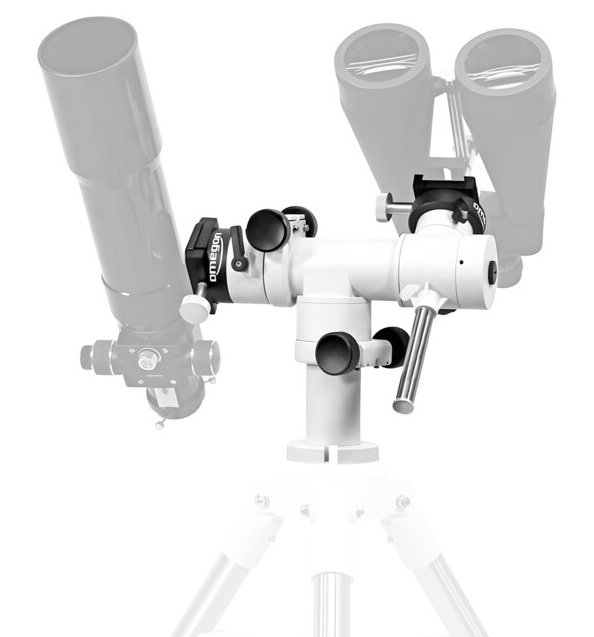
Mit einer azimutalen Montierung kann ein Teleskop in die Höhe und entlang des Horizonts geschwenkt werden. Dieser Horizontalwinkel wird auch Azimut genannt. Azimutale Montierungen können ganz einfach wie ein Fotostativ aufgebaut sein.
Vorteilhaft ist, dass manche azimutalen Montierungen dafür eingerichtet sind, zwei Teleskope gleichzeitig zu befestigen - wie im Bild hier.
Ein besonders geniales und gleichzeitig einfaches Beispiel ist die Dobson-Montierung. Man wollte ein möglichst großes Teleskop auf einer Montierung zum günstigen Preis haben. Das ist auch gelungen: Ein Newton-Teleskop sitzt auf einer Holzbox und lässt sich im Azimut (horizontal) und in der Höhe frei bewegen. Die Konstruktion der Box ist ganz einfach: Sie besteht nur aus wenigen Teilen, die man nach dem Ikea-Prinzip zusammenbaut. Für eine einfache Bewegung besitzt das Teleskop bzw. die Box Gleit- und Drehlager. So bringen Sie das Teleskop meist mit nur einem Finger in jede beliebige Position.
Parallaktische Montierungen sind so konstruiert, dass eine Achse parallel zur Erdachse ausgerichtet werden muss. So muss das Teleskop nur noch um diese Achse - Stundenachse genannt - gedreht werden, um die Himmelsrotation auszugleichen. Das ausgewählte Himmelsobjekt bleibt so immer im Okular zentriert.
Um die Stundenachse parallel zur Erdachse auszurichten, müssen die Nordrichtung und die geographische Breite des Beobachtungsortes bekannt sein. Verfügt die parallaktische Montierung über einen Polsucher, kann dazu auch einfach der Polarstern angepeilt werden.
Ein besonderer Fall der parallaktischen Montierung ist die Fotomontierung. Das sind sehr leicht zu transportierende Montierungen, auf denen Fotokameras aufgesetzt werden können. Die Fotomontierungen ermöglichen so den Ausgleich der Himmelsrotation, der für langzeitbelichtete Aufnahmen notwendig ist. Es handelt sich also im Grunde um sehr kleine, parallaktische Montierungen für die himmelsfotografische Anwendung. Die größeren Modelle der Fotomontierung erlauben auch die Verwendung schwerer Foto-Objektive oder kleiner Teleskope.