
🇬🇧 Mounts in general
A mount is at least as important as the telescope optics. It should be chosen large enough to carry the telescope with low vibration.
Every mount has two axes: With altazimuth mounts, the telescope is moved in altitude and azimuth (horizontal). With equatorial mounts, however, one axis is aligned parallel to the Earth's axis. This is absolutely necessary for astrophotography with long exposure times. With a photo mount, you can use a camera with interchangeable lenses. This is ideal for travel!
The term GoTo refers to a computer control system. This makes it easier to find the desired object.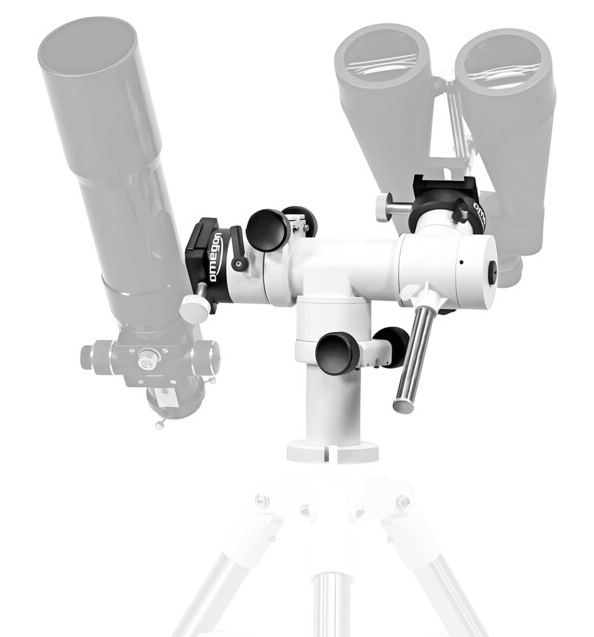 With an altazimuth mount, a telescope can be swiveled in altitude and along the horizon. This horizontal angle is also called the azimuth. Altazimuth mounts can be set up simply like a camera tripod. The advantage is that some altazimuth mounts are set up to attach two telescopes simultaneously - as in the picture here.
A particularly simple example is the Dobsonian mount. The goal was to have the largest possible telescope on a mount at a favorable price. A Newtonian telescope sits on a wooden box and can be moved freely in azimuth (horizontal) and altitude. The construction of the box is very simple: it consists of only a few parts that are assembled according to the Ikea principle. For easy movement, the telescope or the box has sliding and slewing bearings. This allows you to move the telescope into any position, often with just one finger.
Equatorial mounts are constructed in a way that one axis must be aligned parallel to the Earth's axis. This means the telescope only has to be rotated around this axis – called the hour axis – to compensate for the rotation of the sky. The selected celestial object thus remains centered in the eyepiece at all times.
To align the hour axis parallel to the Earth's axis, the north direction and the geographical latitude of the observation location must be known. If the equatorial mount has a polar finder, the Pole Star can also simply be aimed at.
A special type of the equatorial mount is the photo mount. These are very easily transportable mounts on which cameras can be placed. The photo mounts thus enable the compensation of the sky's rotation, which is necessary for long-exposure shots. They are essentially very small, equatorial mounts for astrophotographic use. The larger models of the photo mount also allow the use of heavy camera lenses or small telescopes.
No comments to display
No comments to display